

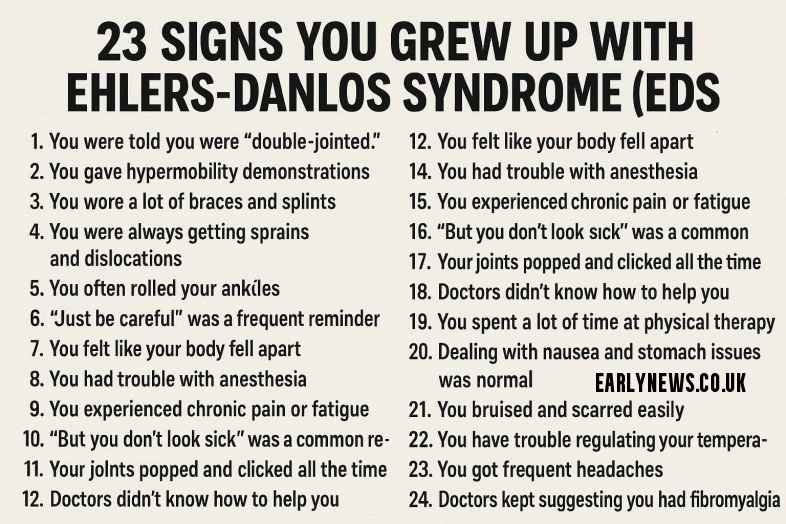
23 Signs You Grew Up with Ehlers-Danlos Syndrome: Ehlers-Danlos Syndrome (EDS) is a group of 13 inherited connective tissue disorders that affect collagen — the structure that supports joints, skin, blood vessels, and organs. In 2026, awareness around hypermobile EDS (hEDS) and related conditions like POTS, MCAS, and dysautonomia has grown rapidly, yet thousands of people still reach adulthood before realizing their childhood symptoms were never “normal.”
Many children with EDS are labeled clumsy, anxious, lazy, dramatic, or overly sensitive instead of medically complex. Looking back, the signs were often there all along.
Important: This guide is educational and not a diagnosis. EDS overlaps with conditions such as Marfan syndrome, Loeys-Dietz syndrome, and Hypermobility Spectrum Disorders (HSD). Always consult an EDS-aware healthcare professional.
1. You Were Always Called “Double-Jointed” or “Bendy”

One of the biggest childhood clues of hypermobile Ehlers-Danlos Syndrome is unusual flexibility. Maybe you could do the splits without stretching, bend your fingers backward, or place your thumb against your forearm — often called a “hitchhiker’s thumb.”
You may have entertained classmates by popping your shoulders or fingers out of place on command. Sitting in a W-position felt natural, while other kids complained it hurt. Adults usually praised your flexibility because it looked impressive, but hidden underneath was often joint instability and pain.
For many people with EDS, flexibility came with constant aching that nobody took seriously. The phrase “you’re lucky to be flexible” became common — even though your joints were slowly overextending beyond safe limits.
2. Sprains, Strains & Subluxations Happened Constantly
Children with EDS often experience repeated injuries that seem excessive for normal activity. Ankles rolled on flat ground. Knees buckled on stairs. Wrists sprained from opening jars or writing too long.
Many people later diagnosed with EDS remember wearing ACE bandages, braces, or compression wraps constantly during school years. Some had shoulders that partially dislocated while carrying backpacks or hips that shifted during sports.
Doctors frequently blamed “weak muscles,” poor coordination, or being accident-prone instead of investigating connective tissue weakness. In reality, unstable ligaments struggle to hold joints in place.
Repeated subluxations — partial dislocations — are especially common in hEDS and often dismissed because the joint “goes back in” on its own.
3. Your Skin Behaved Differently Than Everyone Else’s
Collagen problems don’t only affect joints. Skin symptoms are another major EDS clue.
You may remember having:
- Velvety or unusually soft skin
- Bruises from tiny bumps
- Stretch marks despite being thin
- Slow wound healing
- Wide “cigarette-paper” scars
- Stretchy skin around knees, neck, or elbows
Some children with Classical EDS (cEDS) experience fragile skin that tears easily. Others notice unexplained scars long after playground injuries should have healed.
Many adults with EDS now realize their “sensitive skin” was actually a connective tissue disorder all along.
4. “Growing Pains” Were Actually Chronic Pain
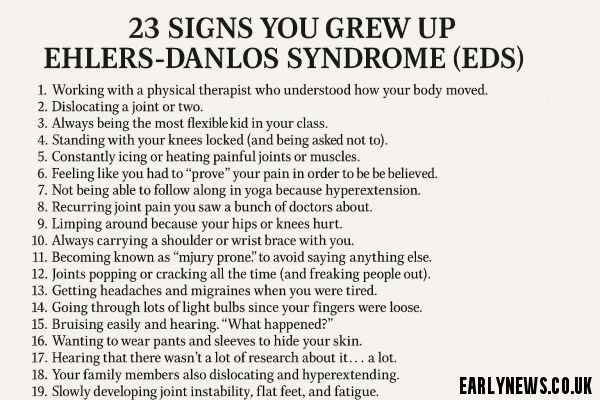
One of the most overlooked EDS signs is persistent childhood pain.
You were probably told your aching legs, knees, hips, or back were simply growing pains. But unlike normal growing pains, yours:
- Happened almost nightly
- Interrupted sleep
- Continued into adulthood
- Got worse in cold weather
- Intensified after activity
Many children with EDS push through severe discomfort because adults normalize it. Some are accused of exaggerating symptoms to avoid sports or school.
Chronic pain in EDS comes from joint instability, muscle compensation, nerve irritation, and inflammation — not simply growth.
5. You Were the “Clumsy Kid”
Poor proprioception — the body’s ability to sense where joints are in space — is common in EDS.
As a child, you may have:
- Walked into walls
- Fallen for no reason
- Dropped objects constantly
- Struggled with handwriting fatigue
- Felt awkward during sports
Gym class often became embarrassing because flexibility didn’t equal coordination. Some children excelled in dance or gymnastics initially but later developed severe pain or instability.
You weren’t careless. Your ligaments simply weren’t providing accurate feedback to your brain.
6. Stomach Problems Controlled Your Childhood
Research now shows up to 90% of people with hEDS experience gastrointestinal symptoms.
Common childhood signs included:
- Chronic constipation
- IBS diagnosis
- Acid reflux (GERD)
- Frequent nausea
- Bloating after small meals
- Alternating diarrhea and constipation
Food Was Complicated
Many children with EDS were labeled “picky eaters” when the real issue involved jaw pain, sensory discomfort, dysmotility, or Mast Cell Activation Syndrome (MCAS).
Certain textures caused nausea. Large meals felt impossible. Some kids avoided school lunches because eating itself became exhausting.
7. You Got Dizzy, Fainted, or Felt Sick Standing Up
A huge percentage of EDS patients also have dysautonomia, especially POTS (Postural Orthostatic Tachycardia Syndrome).
Childhood symptoms often included:
- Head rushes when standing
- Fainting in assemblies or church
- Racing heartbeat
- Heat intolerance
- Exhaustion after mild exercise
- Needing to sit frequently
Teachers and relatives frequently interpreted these episodes as anxiety or dramatics. In reality, stretchy blood vessels in EDS can cause blood pooling and poor circulation.
8. 15 More Childhood Signs of EDS
Many adults diagnosed in 2026 recognize additional clues from childhood, including:
- TMJ jaw popping or locking
- Migraines before puberty
- Flat feet and painful arches
- Extreme fatigue despite sleeping a lot
- Bedwetting past age 7
- Frequent headaches
- Scoliosis or kyphosis
- High, narrow palate
- Crowded teeth needing braces
- Allergies or MCAS symptoms
- Heat sensitivity
- Anxiety tied to dysautonomia
- Spider veins at a young age
- Pulsatile tinnitus
- Hearing “you’re too young to hurt”
Separately, these symptoms seem random. Together, they often point toward connective tissue dysfunction.
What To Do If This Sounds Like Your Childhood
1. Document Your Medical History
Write down childhood injuries, surgeries, chronic symptoms, and family history. Photos showing hypermobility can help because flexibility often decreases with age.
2. Find an EDS-Aware Specialist
Seek a provider familiar with 2026 EDS diagnostic criteria. Rheumatologists, geneticists, and physiatrists experienced with hypermobility disorders are ideal.
3. Rule Out Similar Conditions
Conditions overlapping with EDS include:
- Marfan syndrome
- Loeys-Dietz syndrome
- Hypermobility Spectrum Disorder
- Fibromyalgia
- Autoimmune disorders
Vascular EDS (vEDS) especially requires urgent evaluation because of blood vessel risks.
4. Build Support & Community
Organizations like The Ehlers-Danlos Society, EDS Awareness, and online communities such as #EDSTok help patients feel less isolated after years of medical dismissal.
Why an EDS Diagnosis Matters in 2026
Getting diagnosed later in life can still change everything.
A proper diagnosis may help you:
- Access accommodations at work or school
- Avoid unsafe physical therapy
- Understand chronic fatigue and pain
- Screen for complications
- Validate years of ignored symptoms
- Help family members seek testing
For many adults, diagnosis finally explains why childhood always felt physically harder than it seemed for everyone else.
Conclusion
Growing up with undiagnosed Ehlers-Danlos Syndrome often means years of confusion, gaslighting, injuries, and invisible pain. The “bendy kid,” the “dramatic teen,” the “clumsy student,” or the “lazy child” may actually have been living with a complex connective tissue disorder the entire time.
In 2026, awareness around EDS, POTS, MCAS, and hypermobility disorders is expanding rapidly. Recognizing the signs early can lead to safer treatment, better pain management, and improved quality of life.
If many of these childhood experiences sound familiar, it may be worth discussing EDS with a qualified healthcare professional. Sometimes the missing explanation has been there all along.