


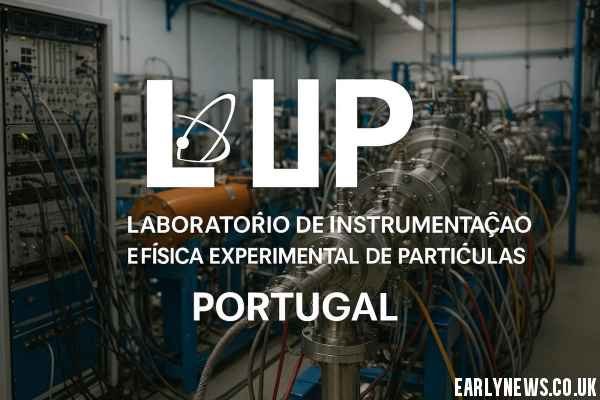
Laboratorio LIP, officially known as the Laboratório de Instrumentação e Física Experimental de Partículas, is one of Portugal’s most important scientific institutions in 2026. Founded during Portugal’s historic entry into CERN, the institute has become a major center for particle physics, detector technology, advanced computing, astroparticle science, and medical physics applications.
Today, LIP operates across Lisbon, Coimbra, and Minho, bringing together more than 170 researchers and specialists working on groundbreaking international collaborations including ATLAS, CMS, CERN upgrades, medical imaging systems, and next-generation detector technologies.
From helping unlock the secrets of the universe to improving cancer diagnostics and radiation therapy, Laboratorio LIP stands at the intersection of science, technology, medicine, and innovation.
What Is Laboratorio LIP? 2026 Official Definition

LIP stands for:
Laboratório de Instrumentação e Física Experimental de Partículas
It is officially recognized as a Laboratório Associado under the Portuguese Ministry of Science, Technology and Higher Education since 2001.
Core Mission of LIP
Laboratorio LIP focuses on several advanced scientific areas:
- Experimental particle physics
- Astroparticle research
- Detector and instrumentation development
- Medical physics applications
- Advanced scientific computing
Its work supports both fundamental scientific discovery and practical real-world technologies.
History of LIP and Portugal’s CERN Entry
LIP was founded in May 1986, the same period Portugal officially joined CERN.
A symbolic milestone occurred on:
January 1, 1986 — when the Portuguese flag was raised at CERN for the first time.
The creation of LIP helped Portugal establish itself within the international scientific community and develop expertise in high-energy physics.
LIP Research Areas: From Particle Physics to Medical Innovation
Laboratorio LIP now operates across multiple scientific disciplines.
1. Experimental Particle Physics
Particle physics remains the institute’s central focus.
LHC Involvement
LIP researchers actively contribute to CERN’s:
- ATLAS experiment
- CMS experiment
These projects study fundamental particles and forces using the Large Hadron Collider (LHC).
Key Technologies and Components
LIP teams help develop:
- Precision Proton Spectrometer (PPS)
- Electromagnetic Calorimeter (ECAL)
- MIP Timing Detector (MTD)
- High Precision Timing Detector
- TileCal hadronic calorimeter
These systems are essential for detecting and measuring high-energy particle collisions.
2. Detector Development
The Detectors Laboratory (DL) is one of LIP’s most important technical divisions.
Main Responsibilities
The lab supports:
- Detector design
- Electronic circuit construction
- Vacuum system engineering
- Repair and calibration systems
Current Projects
Ongoing developments include:
- Large-area RPC-based detector systems
- SNO+ calibration equipment
- Advanced timing technologies
These tools are used in both physics experiments and medical applications.
3. Medical Physics & Healthcare Applications
One of the most exciting areas of LIP research is medical technology.
Medical Uses of Particle Physics
Technologies originally developed for particle detectors are now applied to:
- Medical imaging
- PET scanners
- Radiation therapy
- Biomedical diagnostics
- Cancer treatment technologies
This demonstrates how particle physics research directly benefits healthcare.
4. Advanced Computing & Big Data
Modern particle physics generates enormous amounts of information.
LIP develops advanced computing systems for:
- Big data analysis
- High-performance scientific computing
- Grid computing
- AI-assisted data processing
These tools help researchers process massive datasets produced by CERN experiments.
LIP at CERN: Portugal’s High-Luminosity LHC Role
Laboratorio LIP has remained deeply connected with CERN for nearly four decades.
2022–2026 CERN Activities
The Large Hadron Collider entered its third operation period, and LIP researchers play a major role in upgrading detector systems.
Key Upgrade Areas
LIP teams are helping improve:
- Timing detectors
- Trigger systems
- Calorimeters
- Precision measurement technologies
These upgrades are preparing CERN for the next generation of experiments.
High-Luminosity LHC Goal for 2030
The upcoming High-Luminosity LHC (HL-LHC) project aims to increase collision rates by ten times current levels.
LIP engineers and physicists are actively contributing to this transformation.
Expert Perspective
Researchers Michele Gallinaro and Patricia Conde Muíño described the current period as:
“An incredibly flourishing golden age of particle physics.”
LIP Research Output & Nature Index Rankings 2026
Laboratorio LIP continues gaining recognition for high-impact scientific publications.
2025–2026 Nature Index Data
| Metric | Ranking/Data |
|---|---|
| Overall Articles | 124 |
| Overall Share | 4.57 |
| Global Rank | #1,719 |
| Portugal Rank | #10 |
| Government Sector Rank | #182 globally |
| Portugal Government Lab Rank | #1 |
| Physical Sciences Rank | #923 globally |
Top Scientific Journals
LIP research appears frequently in prestigious journals including:
- Journal of High Energy Physics
- Physical Review Letters
- European Physical Journal C
This publication output strengthens Portugal’s international scientific reputation.
LIP Locations & Team Structure 2026
Laboratorio LIP operates through three major delegations.
Main Locations
Lisbon
The largest administrative and research center.
Coimbra
Important for detector engineering and laboratory development.
Minho
Focused on collaborative scientific projects and research expansion.
Team Size
LIP includes approximately:
- 170 researchers
- 70 PhD scientists
- Engineers
- Technicians
- Data specialists
Detectors Laboratory Personnel
Key staff mentioned include:
- Nuno Carolino
- Orlando Cunha
- Alberto Blanco
These experts contribute to advanced detector construction and testing.
Major International Collaborations in 2026
Laboratorio LIP collaborates with major scientific organizations worldwide.
Key Partnerships
| Organization | Collaboration Area |
|---|---|
| CERN | ATLAS, CMS, LHC |
| SNO+ | Neutrino detectors |
| ESA | Space instrumentation |
| NASA | Scientific technology |
| Medical Centers | Proton therapy, imaging |
These partnerships place LIP at the center of global scientific innovation.
Breakthrough Prize Recognition
The ATLAS and CMS collaborations received the prestigious Breakthrough Prize.
Scholarship Funding
Part of the prize funding supports:
- PhD scholarships
- CERN research opportunities
- Advanced scientific training
This helps prepare future generations of Portuguese scientists.
LIP Technologies & Real-World Applications
LIP’s innovations extend far beyond theoretical physics.
Technology Transfer Areas
Medical Imaging
Advanced PET scanner technologies improve diagnostics.
Muon Tomography
RPC detectors help analyze structures using cosmic particles.
Scientific Computing
Grid computing systems process large-scale research data.
Industrial Engineering
Vacuum systems and electronics developed at LIP also support industrial applications.
Nanotechnology & Sustainable Engineering
LIP researchers are exploring:
- Nanotechnology-enhanced detectors
- Eco-friendly detector materials
- Sustainable instrumentation systems
This aligns scientific advancement with environmental responsibility.
Why Laboratorio LIP Matters to Portugal in 2026
LIP represents one of Portugal’s greatest scientific success stories.
Scientific Internationalization
Portugal’s 1986 CERN membership transformed the country’s scientific landscape.
LIP became the institution responsible for bringing Portuguese researchers into:
- International particle physics
- Advanced detector engineering
- Global scientific collaboration
National Scientific Importance
By 2026, LIP ranks among Portugal’s most respected research institutes.
Historic Significance
Many experts describe LIP as:
“An unavoidable element of the history of scientific research in Portugal.”
Its influence now extends across science, medicine, technology, and education.
Education, PhD Programs & Student Opportunities
LIP plays a major role in training future scientists.
Student Training Areas
Researchers and students gain experience in:
- Detector physics
- Electronics engineering
- Data analysis
- Particle simulation
- CERN experimental systems
CERN Scholarship Opportunities
Breakthrough Prize funding allows PhD students to spend:
Up to two years at CERN
This provides invaluable international scientific experience.
Future Scientific Growth
LIP researchers expect:
- Larger data samples after 2030
- New flagship CERN projects
- Expanded international partnerships
The institute sees a strong future for Portuguese science.
LIP vs Other Physics Laboratories in 2026
| Lab | Country | Focus | LIP Advantage |
|---|---|---|---|
| CERN | Switzerland | LHC Research | Portuguese contribution leader |
| INFN | Italy | Particle Physics | Stronger medical integration |
| IN2P3 | France | Nuclear & Particle | Detector specialization |
What Makes LIP Unique?
LIP combines:
- Fundamental physics
- Medical innovation
- Advanced computing
- Detector engineering
within one integrated research institute.
How to Collaborate With Laboratorio LIP
LIP welcomes scientific and industrial collaboration opportunities.
Research Collaboration
Projects operate through:
- CERN partnerships
- EU Horizon programs
- FCT Portugal funding
Industry Collaboration
The Detectors Laboratory supports:
- Electronic circuit design
- Vacuum systems
- Detector manufacturing
- RPC system construction
Contact Information
- Email: alberto@coimbra.lip.pt
- Phone: (+351) 21 797 38 80
Final Verdict: Why Laboratorio LIP Is Important in 2026
Laboratorio LIP has become one of the most influential scientific institutions in Portugal and an important contributor to global particle physics research.
Its work spans:
- CERN experiments
- Detector technologies
- Medical imaging
- Cancer treatment systems
- Advanced computing
- International scientific education
From helping explore the origins of the universe to improving healthcare technologies, LIP demonstrates how advanced science can create real-world impact.
In 2026, Laboratorio LIP stands as a symbol of Portuguese scientific innovation, global collaboration, and next-generation research leadership.
FAQs About Laboratorio LIP 2026
What does LIP stand for?
LIP stands for Laboratório de Instrumentação e Física Experimental de Partículas.
When was Laboratorio LIP founded?
LIP was founded in May 1986 during Portugal’s accession to CERN.
What research does LIP conduct?
LIP works on particle physics, detector engineering, medical physics, astroparticles, and advanced computing.
Does LIP collaborate with CERN?
Yes. LIP is heavily involved in CERN projects including ATLAS, CMS, and High-Luminosity LHC upgrades.
How many researchers work at LIP?
LIP has approximately 170 researchers, including around 70 PhD scientists.