

Introduction
Hidden within soil, plant debris, and even the stomachs of certain animals, a powerful natural process quietly sustains life on Earth—cellulysis. While it rarely enters everyday conversation, its impact is enormous. Every fallen leaf, every piece of wood, and every crop residue eventually undergoes transformation through this process. Without it, the world would be buried under layers of undecomposed plant matter, and essential nutrients would remain locked away.
Cellulysis is not just about decay; it is about renewal. It represents the transition of complex biological structures into usable energy and building blocks for life. This transformation fuels ecosystems, supports food chains, and increasingly, it is being harnessed by humans to create cleaner energy solutions.
Understanding cellulysis offers a deeper appreciation of how nature manages waste, recycles resources, and maintains balance. It also reveals how modern science is learning from these natural systems to solve some of the world’s most pressing challenges.
What Is cellulysis
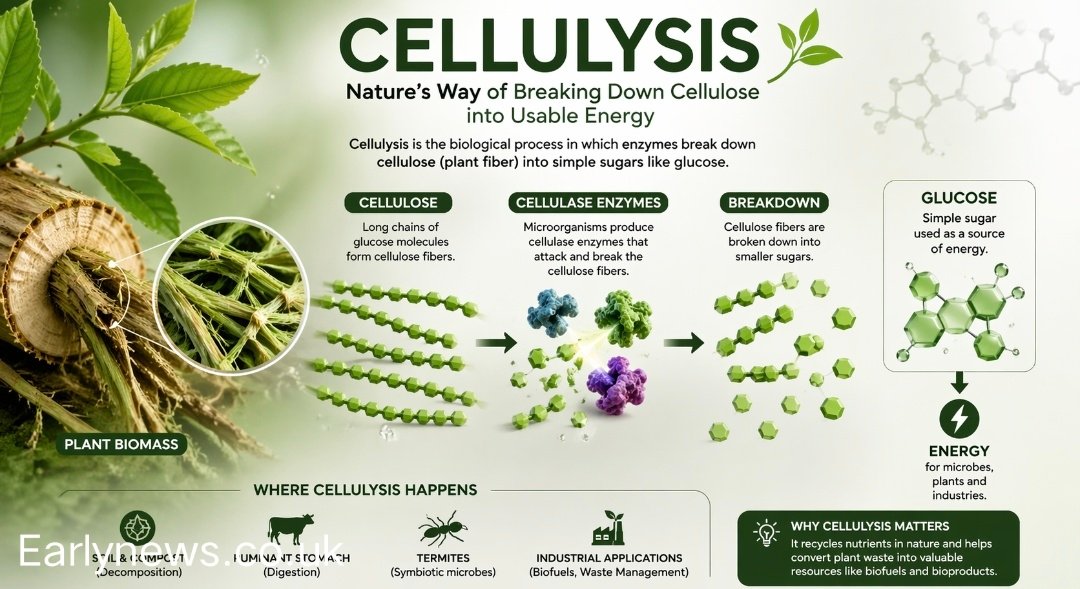
Cellulysis is the biological process through which cellulose, the primary structural component of plant cell walls, is broken down into simpler sugars. This process is carried out mainly by enzymes known as cellulase, which are produced by certain microorganisms such as bacteria and fungi.
READ MORE: aurö: The Quiet Rise of a Name Shaping Modern Identity Today
Cellulose itself is one of the most abundant organic compounds on Earth. It forms the rigid framework of plants, giving them strength and resistance. However, this strength also makes it difficult to break down. Cellulysis overcomes this challenge by using specialized enzymes that target the chemical bonds holding cellulose together.
Through cellulysis, long chains of glucose molecules are separated into smaller units, eventually releasing glucose that can be used as an energy source. This process is essential not only for microorganisms but also for larger organisms that depend on them.
The Complexity of Cellulose Structure
The reason cellulysis is such a fascinating process lies in the structure of cellulose itself. Cellulose consists of glucose molecules linked by strong β-1,4-glycosidic bonds. These chains align side by side, forming tightly packed fibers stabilized by hydrogen bonds.
This arrangement creates a material that is both strong and resistant to chemical attack. It is the reason trees can stand tall for decades and plant fibers can withstand environmental stress. However, it also means that breaking down cellulose requires a highly coordinated effort.
Cellulysis succeeds because it employs multiple enzymes working together. Each enzyme targets a specific part of the cellulose structure, gradually weakening and dismantling it. This multi-step approach ensures that even the most resistant plant materials can eventually be converted into usable forms.
Enzymatic Machinery Behind cellulysis
At the heart of cellulysis lies a sophisticated system of enzymes. These enzymes do not act randomly; they function in a precise and coordinated manner. Endoglucanases initiate the process by cutting internal bonds within cellulose chains, creating openings in the structure.
Exoglucanases then take over, working from the ends of these chains to release smaller sugar units known as cellobiose. Finally, β-glucosidases convert cellobiose into glucose, completing the transformation.
This sequence is crucial. If any part of this enzymatic system fails, cellulysis becomes inefficient. The elegance of this process reflects millions of years of evolution, during which microorganisms refined their ability to extract energy from plant material.
Microbial Role in cellulysis
Cellulysis is largely driven by microorganisms that have evolved specialized capabilities. Fungi are among the most efficient cellulase producers, particularly species like Trichoderma reesei, which is widely used in biotechnology.
Bacteria also play a vital role. Species such as Clostridium thermocellum are known for their ability to break down cellulose in oxygen-free environments. These organisms form complex systems that attach to cellulose fibers and degrade them efficiently.
Microbial communities often work together, creating environments where cellulysis can occur more effectively. This cooperation enhances the breakdown process and ensures that nutrients are fully utilized.
cellulysis in Natural Ecosystems
In nature, cellulysis is a cornerstone of ecological balance. When plants die, their cellulose-rich tissues become part of the organic matter in soil. Microorganisms then begin the process of cellulysis, breaking down these materials and releasing nutrients.
This process is essential for the carbon cycle. Carbon stored in plant biomass is returned to the atmosphere and soil, where it can be reused by other organisms. Without cellulysis, ecosystems would struggle to sustain life, as nutrients would remain trapped in undecomposed material.
Forests, grasslands, and wetlands all depend heavily on cellulysis. It ensures that organic matter does not accumulate excessively and that energy continues to flow through the ecosystem.
cellulysis in Animal Digestion
Certain animals rely on cellulysis to access the energy stored in plant material. Herbivores such as cows and sheep consume large amounts of cellulose but cannot digest it on their own. Instead, they depend on microorganisms living in their digestive systems.
In ruminants, cellulysis occurs in the rumen, where microbes break down cellulose into simpler compounds. These compounds are then converted into energy-rich molecules that the animal can absorb.
Termites provide another striking example. Their digestive systems host specialized microorganisms capable of cellulysis, allowing them to feed on wood. This symbiotic relationship highlights how cellulysis enables organisms to exploit resources that would otherwise be inaccessible.
Industrial Applications of cellulysis
The relevance of cellulysis extends far beyond natural ecosystems. In recent years, it has become a focus of industrial innovation. One of the most promising applications is in the production of biofuels. By converting plant biomass into fermentable sugars, cellulysis enables the creation of renewable energy sources such as ethanol.
Industries are also exploring cellulysis for waste management. Agricultural residues, paper waste, and other cellulose-rich materials can be transformed into valuable products instead of being discarded.
In the textile and paper industries, cellulysis is used to improve processing efficiency and reduce environmental impact. These applications demonstrate how a natural process can be adapted for modern needs.
Challenges in cellulysis Efficiency
Despite its potential, cellulysis is not without challenges. The process can be slow, and the enzymes involved are often expensive to produce. Additionally, the complex structure of cellulose can limit the efficiency of enzymatic breakdown.
Researchers are working to address these challenges by developing more efficient enzymes and optimizing conditions for cellulysis. Advances in biotechnology are making it possible to engineer microorganisms with enhanced capabilities.
Improving cellulysis efficiency is crucial for expanding its industrial applications and making it a viable solution for large-scale energy production.
Future Directions of cellulysis Research
The future of cellulysis lies in innovation. Scientists are exploring new ways to enhance enzyme performance, improve microbial systems, and integrate cellulysis into sustainable technologies.
There is growing interest in using cellulysis as part of a circular economy, where waste materials are continuously recycled into valuable resources. This approach aligns with global efforts to reduce environmental impact and promote sustainability.
As research progresses, cellulysis is expected to play an increasingly important role in energy production, waste management, and environmental conservation.
READ MORE: reprimo: The Silent Guardian of Cellular Balance
Conclusion
Cellulysis is one of nature’s most essential yet overlooked processes. It transforms tough plant material into usable energy, supports ecosystems, and offers promising solutions for modern challenges. From the forest floor to industrial laboratories, its influence is both profound and far-reaching.
What makes cellulysis truly remarkable is its ability to break down one of the most resilient biological materials on Earth. Through the coordinated action of enzymes and microorganisms, it unlocks energy that would otherwise remain inaccessible.
As the world seeks sustainable alternatives and smarter ways to manage resources, cellulysis stands out as a powerful example of how natural processes can inspire innovation. Understanding and harnessing it may be key to building a more balanced and sustainable future.
FAQs
What is the main purpose of cellulysis?
Cellulysis breaks down cellulose into simpler sugars, making energy stored in plant material accessible to organisms and ecosystems.
Why can’t humans perform cellulysis?
Humans lack the necessary enzymes to break down cellulose, which is why it passes through the digestive system as fiber.
Which organisms are best at cellulysis?
Certain fungi and bacteria, such as Trichoderma reesei and Clostridium thermocellum, are highly efficient at cellulysis.
How is cellulysis useful in energy production?
Cellulysis converts plant biomass into fermentable sugars, which can be used to produce biofuels like ethanol.
What limits the industrial use of cellulysis?
High enzyme costs, slow reaction rates, and the resistant structure of cellulose are major challenges in large-scale applications.
READ MORE: https://earlynews.co.uk/